
Myopia Treatment: How We Actually Manage Nearsightedness
At Aggarwal Eye Clinic in Andheri Hospital, myopia is one of the most common conditions we see in school‑going children, college students, IT professionals, and young adults who spend most of their day on screens.
But here’s something we tell our patients upfront: myopia is no longer just about getting stronger glasses every year.
Modern myopia care is about slowing progression, protecting the retina, and making decisions early, especially for children. This is the approach we follow every day in our clinic.
What We Look for First (Before Talking About Treatment)
When a patient walks in for myopia treatment in Andheri East, we don’t jump straight to lenses or drops.
Our first step is understanding how myopia behaves.
- Is the number increasing rapidly?
- Is axial length increasing?
- Is there a strong family history?
- How many hours a day is the child or adult doing near work?
- How much outdoor time is realistically possible in a Mumbai routine?
Why does this matter?
Because progressive myopia increases the lifetime risk of retinal detachment, glaucoma, and myopic macular degeneration, something well documented by the American Academy of Ophthalmology and large population studies published in Ophthalmology and JAMA Ophthalmology.
This is why we treat myopia as a medical condition, not just a refractive error.
Myopia Control in Children: What We Recommend in Real Life
1. Special Myopia‑Control Spectacle Lenses
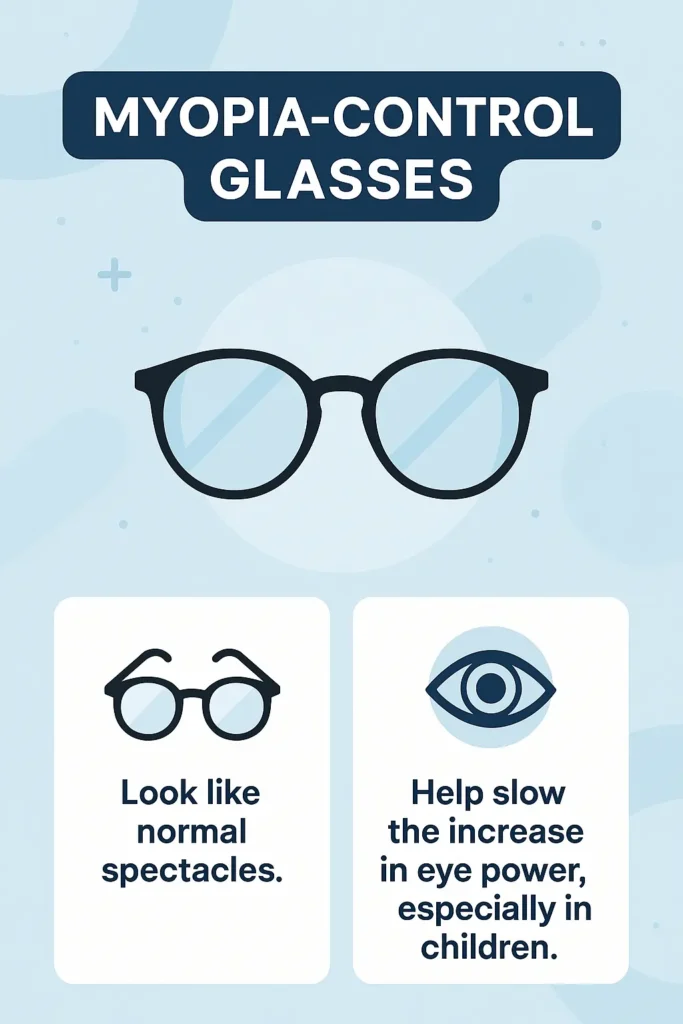
For most families, glasses are the easiest place to start, especially for school‑going children.
In children whose number is increasing faster than expected, we often recommend special myopia‑control glasses. These look exactly like regular spectacles and feel the same to the child.
The difference is in how the lens is designed. These glasses help slow down the eye’s growth, so the power does not increase as quickly as it usually would.
We commonly suggest these lenses for children who are still too young for contact lenses, or for families who want a simple, low‑maintenance option that fits easily into daily school life.
Parents like this approach because the child just wears them like normal glasses, no extra effort, no special routine, while we quietly work on slowing the progression.
2. Dual‑Focus Soft Contact Lenses (Selected Children)

For older children and teenagers, we may recommend dual‑focus daily disposable contact lenses.
Why we like them:
- Strong clinical evidence from long‑term randomised trials
- Consistent slowing of both power increase and axial length
- No overnight wear, which reduces infection risk
We only recommend these when:
- Hygiene is reliable
- Parents and child are comfortable
- Follow‑ups are regular
Myopia control only works when compliance is realistic.
3. Low‑Dose Atropine Eye Drops (Used Thoughtfully)

Atropine drops are not for everyone. We use them only when the child’s number is increasing too quickly.
The dose is very low, safe, and carefully monitored. It works best when used along with special glasses and healthy eye habits.
4. Outdoor Time & Screen Habits (Yes, We’re Practical)

We don’t give unrealistic advice.
Instead of “no screens,” we suggest:
- At least 90–120 minutes of outdoor daylight exposure
- Breaks every 30 minutes during work
- Avoiding very close viewing distances (<30 cm)
Large school‑based randomised trials have shown that exposure to outdoor light significantly reduces the onset and progression of myopia.
Myopia Treatment in Andheri East for Adults: When Surgery Is (and Isn’t) Right

Many adults come to us asking about LASIK as soon as they hear “myopia.”
Our rule is simple: Stable myopia first. Surgery second.
If the power has been stable and the cornea is healthy, we may discuss:
- LASIK
- SMILE
- ICL (implantable contact lens) for higher numbers or thinner corneas
At Aggarwal Eye Clinic, we strictly follow AAO refractive surgery guidelines:
- Detailed corneal topography
- Tear‑film evaluation
- Risk counselling (dry eye, ectasia, future presbyopia)
We also explain something many clinics don’t emphasise enough:
Laser surgery corrects vision; it does not reverse the structural risks of high myopia.
That’s why lifelong retinal checks remain important even after surgery.
Why Patients Look for the Best Eye Hospital in Andheri East and What Actually Matters
We often hear patients say they are searching for the Best Eye Hospital in Andheri East.
In our experience, what truly makes a difference is:
- Evidence‑based myopia control options (not just glasses)
- Ability to measure and monitor axial length
- Honest counselling about what will and won’t work
- Long‑term follow‑up, not one‑time treatment
That’s the model we follow at Aggarwal Eye Clinic and why many of our myopia patients stay with us for years.
Our Final Word as Eye Doctors
Myopia is increasing globally, and Mumbai is no exception.
But with early intervention, structured monitoring, and the right combination of treatments, we can slow progression and protect vision in the long term.
If you are looking for myopia treatment in Andheri East, don’t settle for stronger glasses alone.
Ask about control. Ask about risk. Ask about the future of your eyes.
That’s the conversation we have every day in our clinic.